
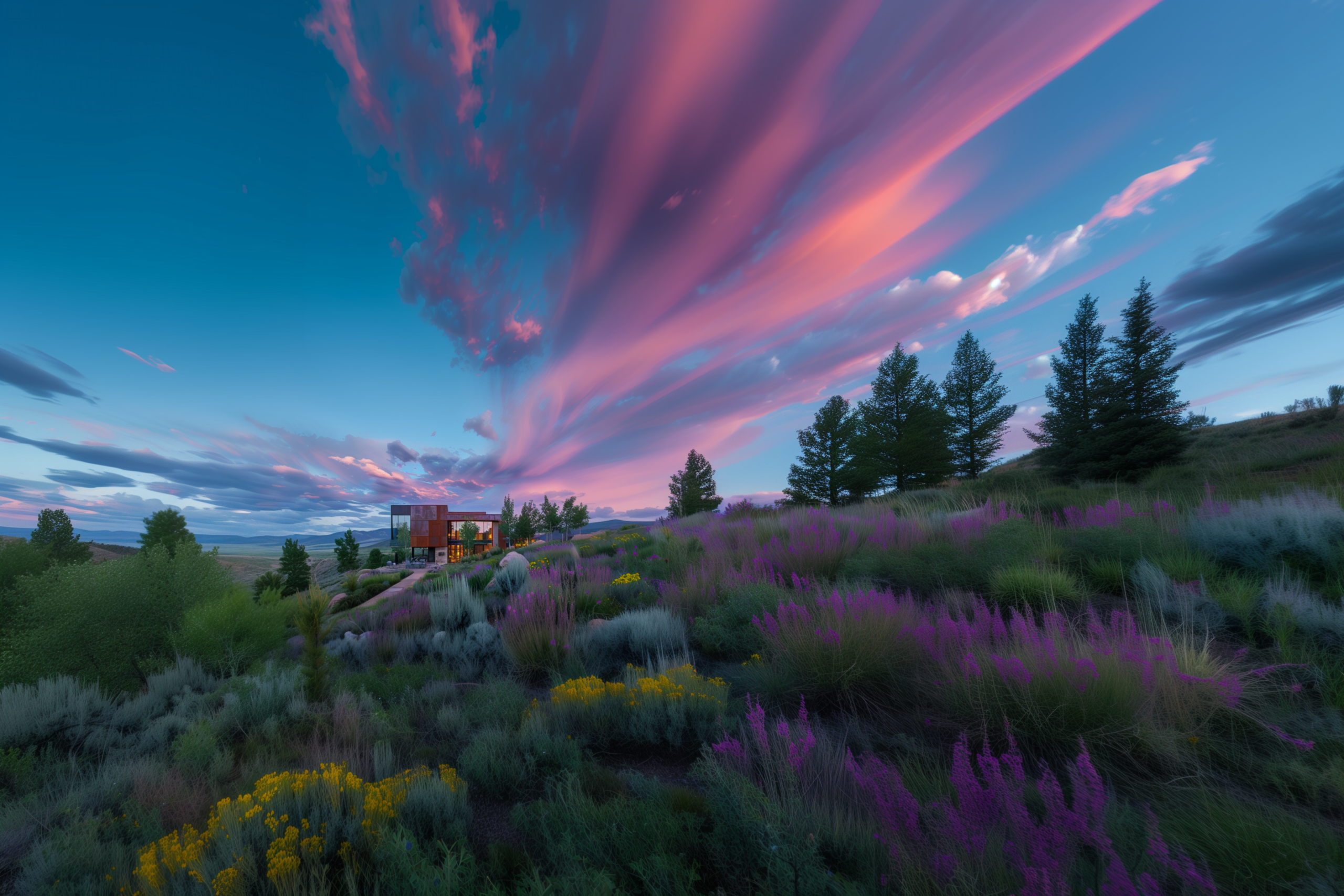
Luxury Modern Ranch Homes: Why Single-Story Living Is Having a Major Moment
Walk into a luxury modern ranch home today, and you’ll forget everything you thought you knew about single-story living.
Gone are the cramped hallways and boxy rooms of suburban sprawl.
Instead, you’ve got 14-foot ceilings soaring above polished concrete floors, walls of glass dissolving into private courtyards, and kitchens that flow seamlessly into living spaces designed for how we actually live.
I had this transformation in mind when designing our Bloque Residence in Boulder.
We were aiming for simplicity without sacrificing sophistication.
What emerged was 2,000 square feet of concrete surfaces that regulate temperature naturally, strategic openings that frame mountain views, and a layout that makes daily life feel effortless.
People are realizing that luxury isn’t just square footage.
It’s spaces that work beautifully – ergonomically and economically – at human scale.

The Ranch Home’s Remarkable Evolution
Today’s luxury ranch has about as much in common with 1950s tract housing as a Tesla does with a Model T.
The history traces back to Frank Lloyd Wright’s Prairie School movement, where homes hugged the earth with intention.
Long, low profiles weren’t accidents.
They were deliberate choices to create harmony between building and landscape.
According to the Frank Lloyd Wright Foundation, Wright’s Usonian homes pioneered open floor plans and natural material use that define modern ranch architecture.
Contemporary architects have taken those principles and pushed them into entirely new territory:
- Roof lines that create drama while maintaining horizontal emphasis
- Material palettes limited to three or four choices for visual power
- Window walls that make gardens feel like living rooms
- Ceiling variations that define spaces without walls
- Courtyards that bring light deep into floor plans
- Smart home systems integrated from conception
The American Institute of Architects reports that requests for single-story homes have increased 42% among custom home clients since 2020.
People choosing ranch homes are, at the same time, reimagining what single-story living can be.
Why Single-Story Living Makes Perfect Sense Now
“But don’t you lose space without a second floor?”
That’s usually the first question clients ask when I suggest a single story.
My answer – that there are pros and cons to both – is often surprising to them.
But think about it:
Every staircase eats up roughly 80 square feet per floor.
That’s 160 square feet doing nothing but connecting levels.
In a ranch home, that space becomes a meditation room, a larger kitchen, or a proper mudroom for Colorado living.
Our D Residence project captures this perfectly.
By keeping everything on one level with a walkout lower level, we created direct connections between living spaces and a planned container pool.
No trudging up and down stairs in wet swimsuits.
And the benefits multiply:
- Aging in place becomes natural, not an afterthought
- Every room connects directly to outdoor spaces
- Natural light reaches deeper into homes
- Cleaning and maintenance simplify dramatically
- Future modifications cost less without structural complications
- Energy efficiency improves with simpler geometries
According to AARP’s Livability Index, single-story homes score highest for long-term livability across all age groups.
We’re talking about a long, dynamic life here – not just retirement.
Design Elements That Define Modern Luxury Ranch
The magic happens in the details.
Take rooflines.
Traditional ranches used simple gables or hip roofs that disappeared into the background.
Today’s versions use shed roofs, butterfly designs, or asymmetrical forms that create visual interest while channeling rain and snow strategically.
Materials tell the story.
Wide-format siding emphasizes horizontal lines.
Board-and-batten in 12-inch widths reads completely differently than narrow clapboard.
According to Architectural Digest, the trend toward larger-scale materials reflects our desire for calmer, less cluttered environments.
For this, windows deserve special attention:
- Floor-to-ceiling glass on private elevations
- Clerestory windows for light without visibility
- Corner windows that make walls disappear
- Automated shades for privacy and climate control
- Triple-pane glass for high-performance home standards
Interior volumes work differently too.
Without stairs interrupting sightlines, spaces flow more naturally.
But flow doesn’t mean formless.
The best ranch homes create distinct zones through ceiling changes, material transitions, and well-placed built-ins.

Indoor-Outdoor Living Perfected
Another way ranch homes really and truly shine?
When everything sits at ground level, the barrier between inside and outside practically vanishes.
I learned this designing homes that embrace modern luxury features while staying connected to their sites.
Outdoor rooms become genuine extensions of interior spaces.
Not afterthoughts – but integral parts of daily life.
In Colorado’s climate, this requires thoughtful planning:
- Deep overhangs that shelter outdoor spaces from sun and snow
- Outdoor fireplaces extending usable seasons
- Courtyards that create micro-climates
- Kitchen gardens steps from cooking spaces
- Pool areas that feel like outdoor living rooms
- Lighting that makes evening use natural
The National Association of Landscape Professionals notes that outdoor living spaces add more value to ranch homes than any other style due to superior integration.
Our creative journey has shown us that the best outdoor spaces feel inevitable, not added.
Creating Open Floor Plans With Purpose
Open floor plans can fail spectacularly.
I’ve walked into homes that feel like airplane hangars: vast, echoing, and somehow both too big and too small simultaneously.
Getting this right requires understanding that open doesn’t mean undifferentiated.
Great ranch floor plans create variety within openness:
- Kitchen islands that organize without blocking
- Ceiling coffers that define dining areas
- Built-in shelving as subtle room dividers
- Flooring changes that signal transitions
- Lighting zones for different moods
- Furniture placement that creates natural paths
Our custom home design process always includes detailed studies of how spaces will actually be used.
Traffic patterns matter more when everything’s on one level.
The National Kitchen and Bath Association recommends minimum 42-inch passages in single-story homes to prevent bottlenecks.
But guidelines are just starting points.
Real design comes from understanding how your specific family moves through space.

Material Selection and Privacy Strategies
Material choices in ranch homes require special consideration.
Long, low profiles mean materials repeat extensively.
Choose wrong, and monotony sets in.
But choose right, and you create rhythm.
Natural materials excel here:
- Stone anchors homes to their sites
- Wood adds warmth without overwhelming
- Concrete provides modern simplicity
- Metal accents add contemporary edges
- Glass maximizes transparency strategically
According to the National Association of Home Builders, material costs for ranch homes run 10-15% higher due to increased exterior surface area.
But durability improvements often offset initial investments.
Privacy requires creativity when everything’s at eye level.
Here are a couple of solutions we’ve developed:
- Courtyard designs that create private outdoor rooms
- Strategic window placement avoiding sight lines
- Landscape berms that screen without walls
- Clerestory windows maintaining light with privacy
- Smart glass technology for instant opacity
- Entry sequences that create transition zones
Energy Efficiency Advantages
Ranch homes offer surprising energy advantages.
Simple geometries mean better building envelopes.
According to the U.S. Department of Energy, single-story homes typically achieve 15-20% better air sealing than multi-story equivalents.
Our Bloque Residence uses concrete’s thermal mass to moderate temperature swings naturally.
No complex systems needed here!
Just smart design working with physics.
Performance benefits include:
- Reduced stack effect improving comfort
- Simpler HVAC distribution increasing efficiency
- Better passive solar potential with long south walls
- Easier continuous insulation installation
- Ground coupling for temperature moderation
- Natural ventilation patterns without vertical complications
The Environmental Protection Agency’s ENERGY STAR program notes that properly designed ranch homes can achieve certification more easily than multi-story homes.
Smart Technology and Future Flexibility
One of the greatest advantages of luxury ranch homes, in my view and from a design perspective at least, is their adaptability.
Ranch homes accommodate changing needs beautifully.
Without load-bearing complications from upper floors, walls can move.
Spaces can transform.
What starts as a home office becomes a nursery, then a teen suite, then a caregiver apartment.
All without major structural work.
According to the Consumer Technology Association, single-story homes integrate smart technology more effectively due to simplified infrastructure.
Wi-Fi coverage improves.
Automated systems install cleanly.
Accessibility features add easily.
A handful of tried-and-tested future-proofing strategies I like:
- Extra-wide doorways from the start
- Blocking in walls for future grab bars
- Conduit for technology upgrades
- Plumbing rough-ins for potential bathroom additions
- Electrical capacity for vehicle charging
- Structural capacity for solar additions

Understanding the Investment
Let’s talk honestly about costs.
Ranch homes typically cost more per square foot than two-story homes.
You’re paying for more foundation.
More roof.
More land.
But here’s what the numbers miss: you’re paying for a lifestyle.
According to the National Association of Realtors, ranch-style homes in luxury markets appreciate steadily and appeal to the broadest buyer pool when selling.
They’re timeless, even as they’re trendy.
Cost factors to consider:
- Foundation costs increase with footprint
- Roofing square footage doubles compared to two-story
- Site work extends with horizontal spread
- Premium for accessible design throughout
- Long-term savings on maintenance and utilities
- Higher resale appeal offsetting initial investment
Our guide to building timelines helps clients understand how ranch construction differs from vertical building.
Making Modern Ranch Living Your Reality
Luxury modern ranch homes represent a fundamental shift in how we think about residential design.
There’s something whimsical and nostalgic about them, but at the same time, they enhance daily life while connecting us to our landscapes.
I’ve honestly seen clients discover freedoms they didn’t know they were missing after building a ranch home.
The executive who hosts dinner parties that flow from kitchen to dining to patio without barriers.
The family whose teenagers actually hang out in common areas because spaces feel connected, not divided.
This is what modern ranch design offers: sophistication without pretension.
Luxury defined by livability.
Homes that function as beautifully as they look.
Ready to explore how a luxury modern ranch could transform your lifestyle?
Contact us for a complimentary discovery consultation.


